

A few weeks ago a friend visiting from Berlin asked me, half-seriously, why he should still bother with India. The NIFTY has gone nowhere for two years, he said, the rupee keeps sliding against the euro, and foreign investors are heading for the exits. He wasn’t wrong about any of those three facts. He was wrong about what they add up to.
The backdrop he left out
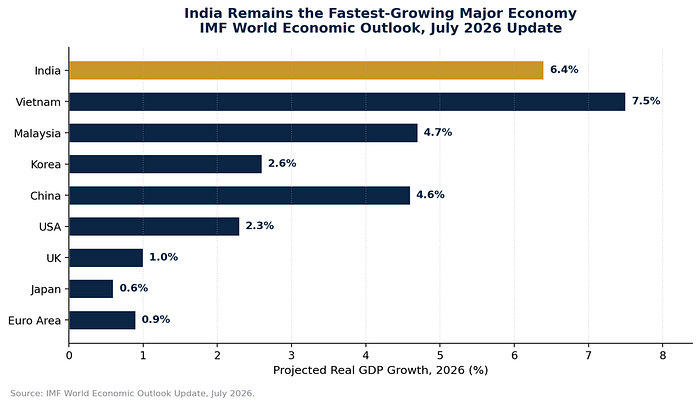
The IMF’s July 2026 update puts India’s real GDP growth at 6.4% for FY27. That is trimmed slightly because of higher energy prices after the Iran-US conflict, and it is still the fastest pace among the world’s major economies. In August 2025 S&P upgraded India’s sovereign rating for the first time in eighteen years, just days after Washington slapped a 50% tariff on Indian goods. The rating agencies were pricing fundamentals, not the week’s headlines.
India also pulled in over $81 billion of FDI in FY25, roughly 90% of it through the automatic route with no government approval needed. Net FDI is another matter. It collapsed to around $0.4 billion, the lowest in more than two decades, as repatriation by foreign investors rose to $51.5 billion. The RBI reads this as a maturing market where capital moves freely both ways. A reasonable view, but not the only one, and a fair account of India holds both figures at once.
The flat NIFTY
This one’s just true. The NIFTY 50 sat around 24,479 in July 2024, touched an all-time high near 26,277 that September, took an 11% hit in March 2026, and is back roughly where it started.
But an index level is not an investor’s return. The headline index leaves out dividends. It hides sectors such as financial services, capital goods and consumer goods that quietly outperformed underneath it. And it ignores the millions of Indians who kept investing every single month through SIPs, which hit record inflows in March 2026. The NIFTY’s ten-year CAGR still runs in the low-to-mid teens. Two flat years is real. It is not a verdict on the decade.
The falling rupee
The premise is correct: the rupee has weakened roughly 47% against the euro over the past decade, and no honest case for India pretends otherwise. I ran the numbers both ways. A euro investor who went into something tracking the NIFTY’s long-run return ten years ago, and converted back at today’s much weaker rate, would still land broadly level with the DAX on a total-return basis, and in the more typical scenario modestly ahead of it. Even in a severe stress case, with depreciation running at roughly double its historical pace for ten straight years, a euro investor starting today still ends with a positive return ahead of typical European rates. Currency risk is a real cost. India’s growth has, historically, more than paid for it.
The departing foreigners
FIIs did sell hard in the first half of 2026, pulled home by high US Treasury yields and spooked by the Iran-US conflict. What the headline leaves out is who was buying. Indian mutual funds, insurers and pension money net-bought almost as much as the entire FII outflow, with a record month in March 2026, the very month markets fell hardest. By mid-June the FIIs had turned net buyers again.
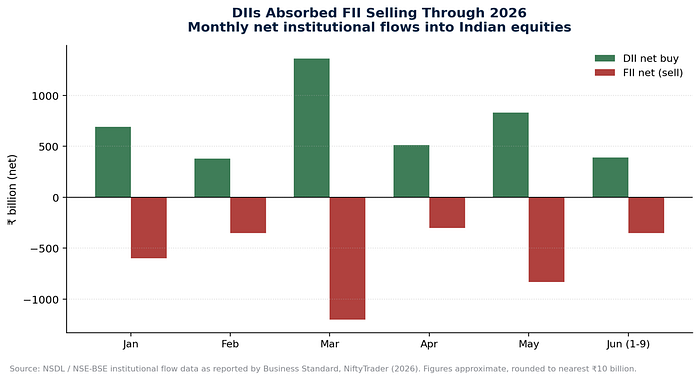
FIIs left. Domestic money filled the gap. Then FIIs came back. That is a market that has grown a second engine, not one that has been abandoned.
And the shocks
Indian markets have taken a beating from every major global shock of the past two decades. The 2008 crisis knocked the Sensex down more than 50%, COVID took the NIFTY down around 35 to 40% in weeks, and this March brought the worst monthly fall since COVID. What has changed is the recovery time. 2008 took roughly four years to win back the prior highs. COVID took eight months. The March 2026 fall stabilised within weeks, helped by that same domestic buying. Through all of it, India’s growth trajectory barely moved.
Every one of these objections starts from something real, and a credible case for India doesn’t pretend any of it away. I don’t think readers trust arguments that do. None of this is a guarantee of future returns, and nobody should size an allocation to a blog post. But “there’s nothing here” is a harder case to make once you’ve actually finished the sentence.
The full version, with the currency calculations worked through, is on iyersellmer.com.
Figures drawn from IMF, S&P Global, RBI, NSDL and NSE/BSE data current to July 2026. This is a personal analytical piece, not investment advice.